




Generative AI for Business: Benefits, Challenges, and Future Trends

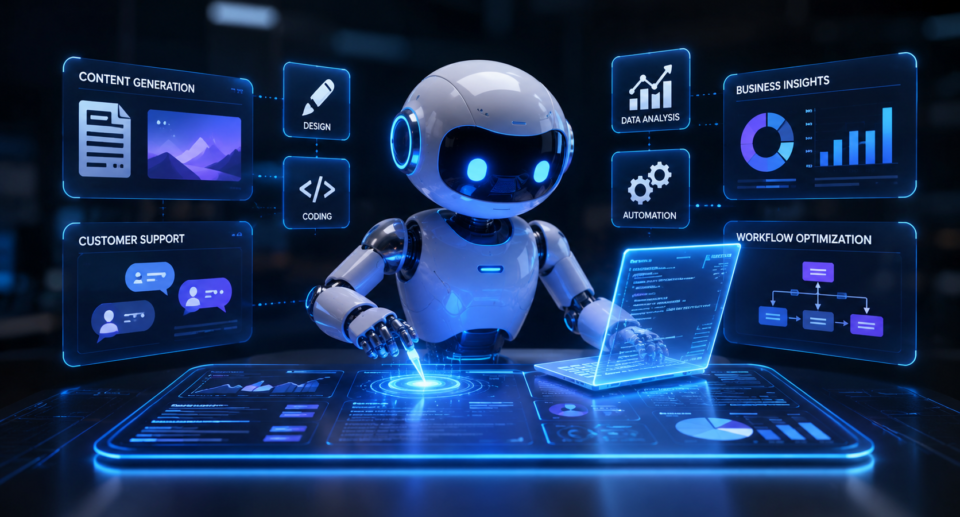
Generative AI (Gen AI) has rapidly evolved from an experimental technology to a valuable business tool in just a few years. Companies such as Shopify, Microsoft, and Salesforce use AI in their daily operations. Many startups use AI to create content, assist customers, and automate repetitive tasks. By 2026, all types of businesses will adopt it, working faster by saving time, reducing costs, and enabling new ways to collaborate across marketing, operations, sales, and software teams. By 2026, it will represent the most significant shift in business technology since the advent of the Internet. At the same time, leaders are learning that technology requires careful oversight due to risks such as incorrect outputs, privacy concerns, and bias.
While there are challenges associated with generative AI, it is also generating new opportunities for innovation, productivity, and efficiency. Traditional AI systems evaluate existing data and make predictions based on that information. Generative AI can create entirely new content, including text, images, videos, code, and even business reports. This ability is transforming how businesses operate, interact, and innovate. This article provides a clear roadmap for businesses to start their generative AI journey. It defines what generative AI is, how businesses are utilizing it, its key benefits, and why it is becoming an essential part of modern business strategies.
What Is Generative AI?
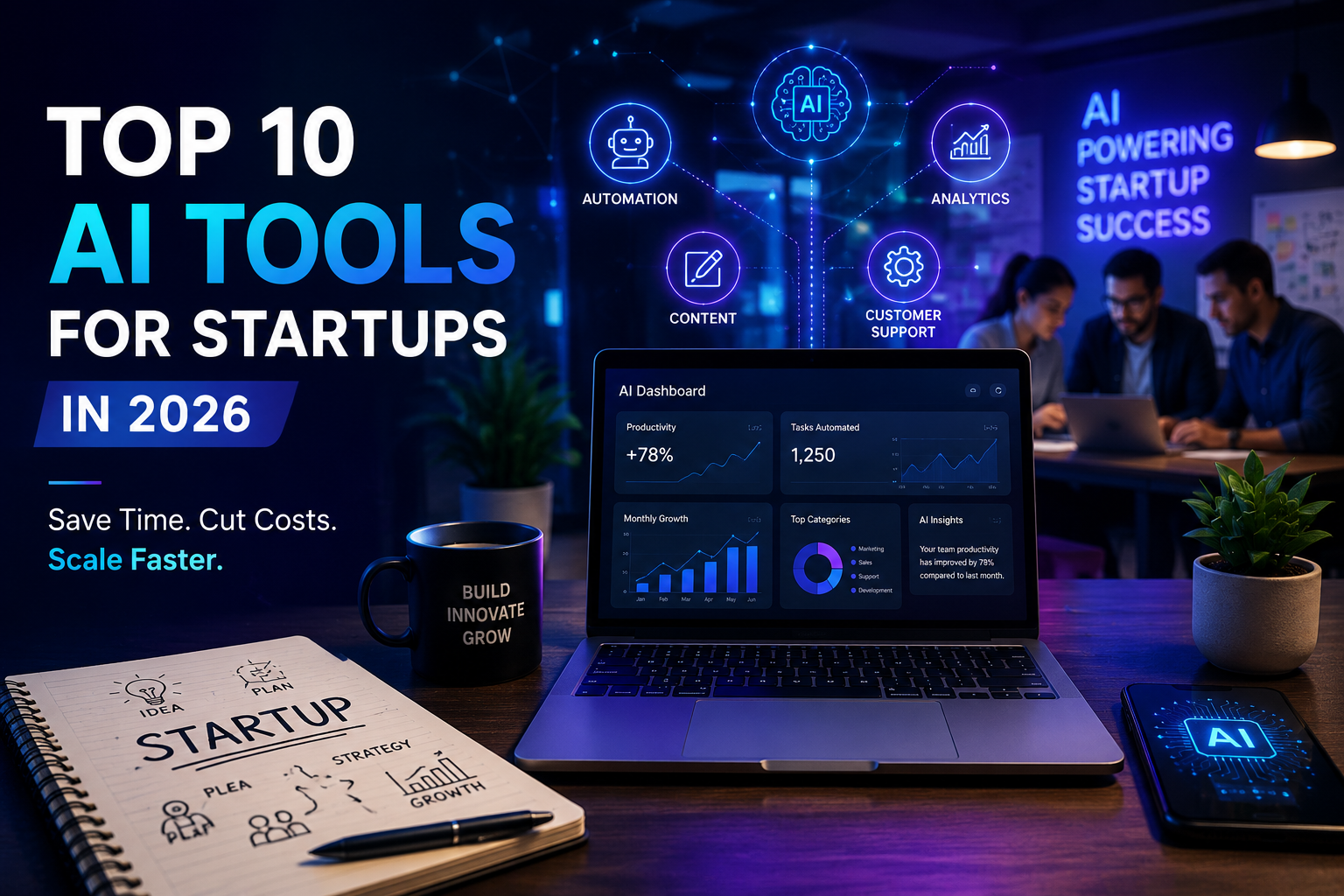
Generative AI is a type of artificial intelligence that generates new content, such as text, images, code, audio, and video, based on patterns rather than solely analyzing existing information. Many popular AI tools have made this technology accessible to individuals and businesses. Popular examples include ChatGPT and Gemini, which help create written content, Claude, Midjourney, and Adobe Firefly. These tools help businesses with writing, brainstorming, design, and automation. In practice, these AI tools for startup enable teams to draft content more efficiently, generate ideas, support customers, and expedite creative work.
Unlike traditional AI, which mainly classifies data or predicts outcomes, generative AI produces original outputs based on user instructions. Platforms such as ChatGPT help create written content; AI coding assistants support software developers, while image-generation tools produce marketing visuals and product concepts within minutes. As AI technology continues to evolve, organizations across industries are integrating generative AI into their daily operations to improve efficiency and remain competitive in a rapidly changing digital economy.
How Businesses Are Using Generative AI
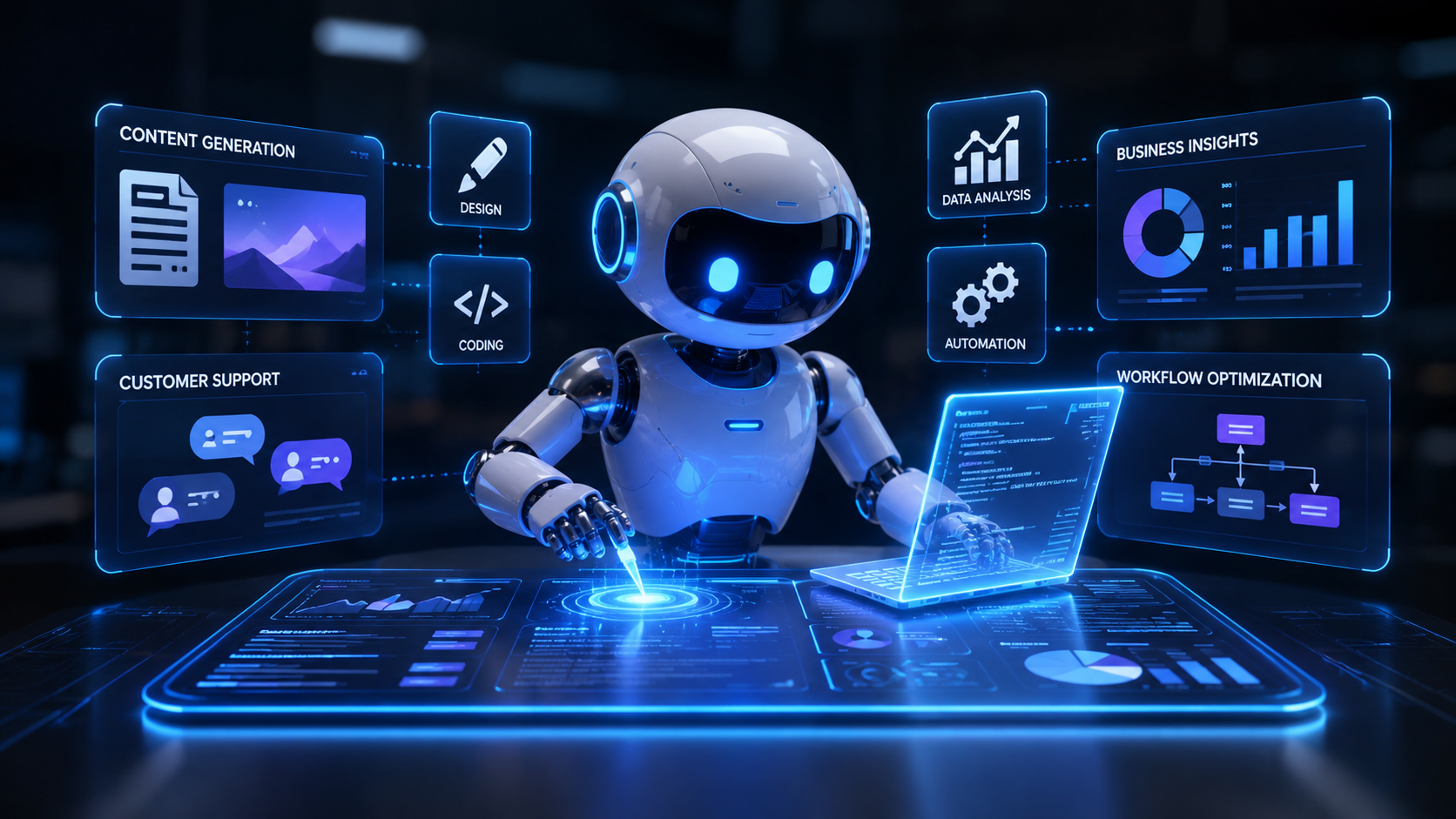
Generative AI is revolutionizing almost every aspect of business operations. According to McKinsey, 78% of organizations use AI in at least one business function. It serves as a strong assistant that increases productivity, fosters creativity, and helps teams make better decisions, rather than replacing workers.
Content Creation
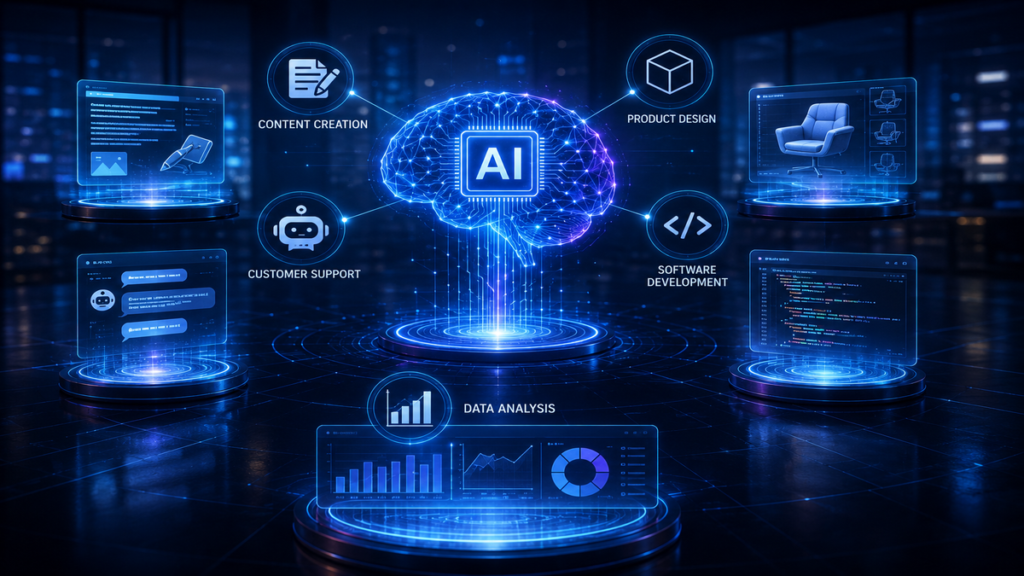
Many enterprises, such as Shopify merchants, often use AI to generate product descriptions, while HubSpot integrates AI to assist marketers in drafting blog posts and email campaigns. Teams that need to generate a large amount of content while maintaining a consistent message will find this especially helpful. Businesses are using AI to support content workflows rather than completely replace human editors, as demonstrated by real-world use cases.
Customer Support
AI chatbots and virtual assistants are now common in customer service because they can instantly answer routine questions, reducing response times on their websites and mobile applications. These virtual assistants answer common customer questions, provide product recommendations, assist with order tracking, and offer 24/7 support. This improves response times while allowing human representatives to focus on more complex customer issues.
Companies like Klarna and Intercom utilize AI-powered assistants to answer common customer questions and then route more complex cases to human agents.
Product Design
Companies can use generative AI to create product concepts, packaging ideas, marketing visuals, and design prototypes. It is also helping design teams to create mockups, explore design ideas, and test product concepts more quickly. Designers can generate visual variations in minutes rather than starting from scratch each time. This makes it easier to experiment early and improve products before investing heavily in full development.
Software Development
Developers increasingly rely on generative AI to assist with coding, test generation, documentation, identifying programming errors, explaining complex functions, and automating repetitive coding tasks. GitHub Copilot helps developers write boilerplate code and identify potential bugs more quickly. Developers utilize AI coding assistants to expedite routine tasks, allowing them to focus more on architecture, problem-solving, and quality control. This is one of the clearest examples of AI in business, improving workflow efficiency across technical teams.
Data Analysis
Generative AI can summarize detailed reports, explain trends, and turn complex data into readable insights for managers. Managers can quickly gain key insights without spending hours reviewing large amounts of information, enabling faster, more informed decision-making. Instead of manually preparing every summary, teams can use AI to draft an initial analysis and then refine it with human judgment. This is valuable for business AI use cases where speed is crucial, but accuracy still requires review.
Key Benefits of Generative AI for Business
Businesses are investing in generative AI because it delivers noticeable advantages across multiple areas. When applied strategically, AI helps organizations become more effective, creative, and customer-focused.
Increased Productivity
One of the most significant benefits of generative AI is its ability to automate repetitive tasks. Employees spend less time drafting documents, writing emails, conducting research, and performing design and coding tasks. Instead, teams can focus more on strategy, creativity, and higher-value decisions. This improves overall workplace efficiency without increasing workloads. 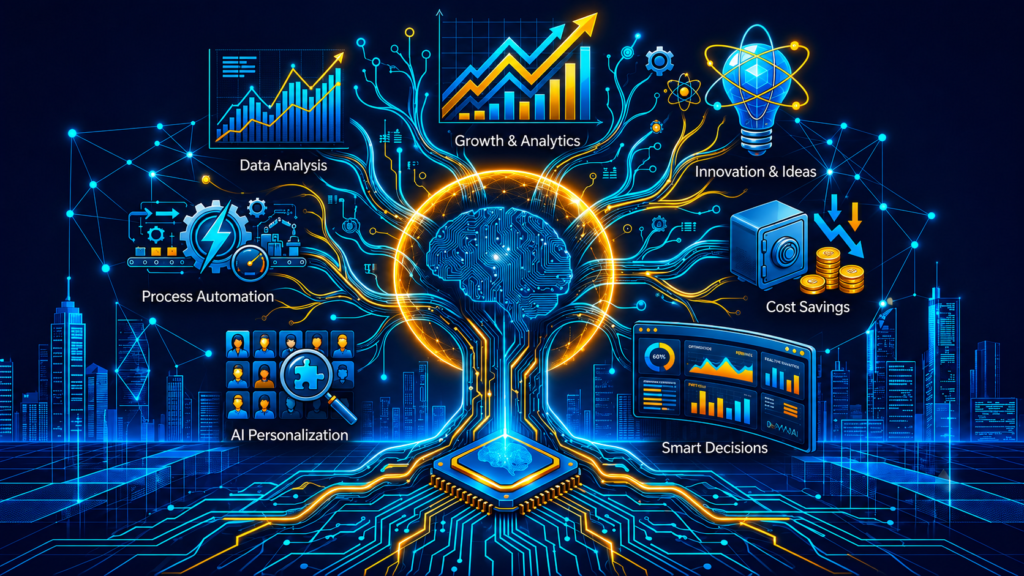
Cost Reduction
Generative AI can lower operating costs by automating repetitive tasks and reducing manual effort such as support, content production, and internal reporting. Businesses also save time in early-stage ideation and drafting, which can shorten project cycles. Over time, this can lead to significant efficiency gains, particularly for small and mid-sized companies.
Faster Decision-Making
AI-generated summaries, recommendations, and scenario ideas help leaders move more quickly from data to action. Instead of waiting for long manual reports, managers can get faster insights and compare options more easily. In competitive markets, that speed can make a real difference.
Personalized Customer Experience
Generative AI helps businesses create more personalized messages, offers, and service interactions. A customer may receive product recommendations, email copy, or support answers tailored to their needs and behavior. This kind of personalization can improve engagement and customer satisfaction.
Improved Creativity and Innovation
Generative AI acts as a brainstorming partner, producing fresh ideas, alternative copy, and new design directions. It helps teams explore more options in less time, which is particularly useful for campaigns, products, and branding efforts. For many organizations, this is one of the most practical benefits of generative AI because it expands creative capacity without requiring a larger team.
Challenges of Using Generative AI
While generative AI offers numerous benefits, companies should be aware of its drawbacks before incorporating it into their regular operations. Implementation must be carried out responsibly to maximize benefits and reduce risks.
Data Privacy
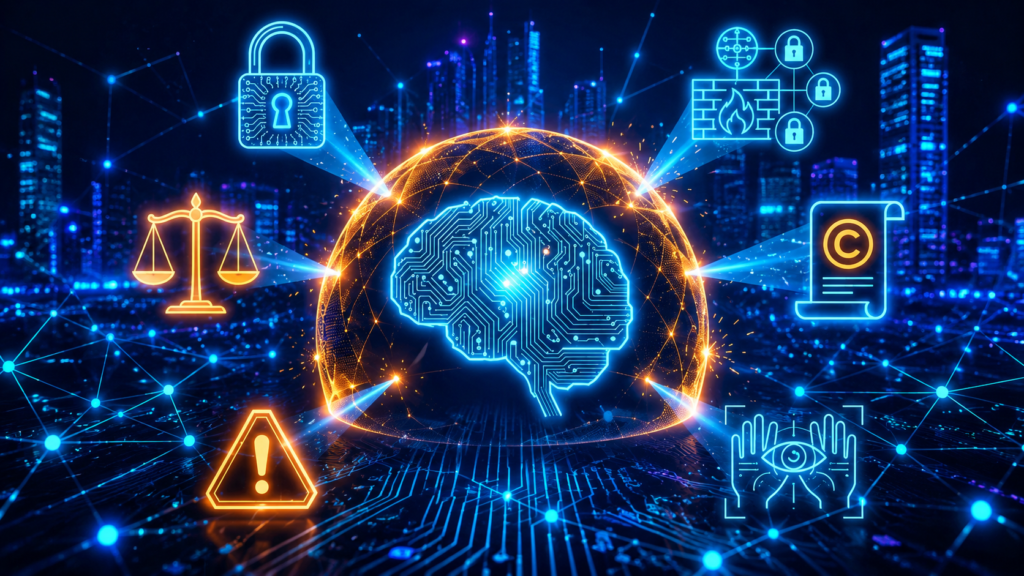
Many AI tools process large amounts of information to generate responses. Businesses must be cautious when handling confidential customer data, financial records, or internal documents, including information they share with AI systems. Sensitive customer data, internal plans, and confidential documents can create risks if sent to the wrong platform or stored insecurely. Strong policies and approved tools are essential for safe use.
AI Hallucinations
Generative AI can sometimes produce confident but incorrect answers. These mistakes, often referred to as AI hallucinations, can affect reports, customer communications, or decision-making if people trust outputs without verifying them. That is why verification is still necessary for anything important.
Copyright and Intellectual Property
AI-generated content can raise questions about ownership and copyright. Questions around ownership and copyrighted material remain a major issue in AI business trends. Companies need to know whether AI-generated content is original, whether it may infringe on protected works in their training data, and how usage rights apply. Human review is important, especially for marketing assets and public-facing materials, to avoid unintentional plagiarism.
Bias in AI Models
AI models can reflect biases present in their training data, which may result in unfair or unbalanced outputs. In business settings, this can affect hiring, customer service, content recommendations, and product decisions.
As a result, AI-generated outputs can sometimes reflect unfair assumptions or produce discriminatory content. Companies should regularly monitor their AI systems and implement ethical guidelines to ensure the fair and responsible use of these systems.
Employee Training and Adoption
Introducing Generative AI into the workplace requires more than simply purchasing new software. Even the best AI tools for business fail if teams do not know how to use them well. Employees require training on prompting, validation, security, and when to rely on their own judgment. Adoption is not only a technology issue but also a change-management issue. Organizations that invest in AI education are more likely to achieve successful long-term adoption.
Future Trends of Generative AI in Business
The future of generative AI looks increasingly tied to workplace automation and decision support. Industry research indicates that AI assistants are becoming standard tools, with more autonomous workflows and hyper-personalized experiences across various business functions.
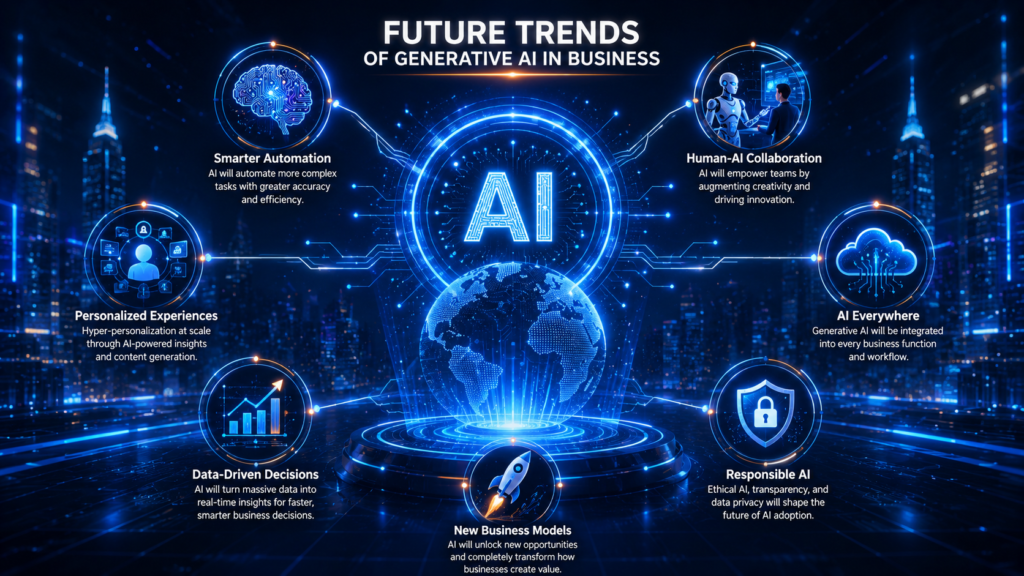
- One of the biggest trends is the growth of AI-powered workplace assistants that help employees write documents, summarize meetings, analyze data, and manage daily tasks more efficiently. These intelligent assistants are becoming a standard part of modern business workflows.
- Businesses are also moving toward hyper-personalization, using AI to deliver customized marketing campaigns, product recommendations, and customer experiences tailored to individual preferences and behavior.
- Another significant development is the increase in multimodal AI, which can understand and produce text, images, audio, and video within a single platform. This will enable businesses to create comprehensive marketing campaigns and digital content more quickly than ever before.
- Industry-specific AI solutions are also becoming more common. Healthcare providers, financial institutions, manufacturers, retailers, and educational organizations are adopting specialized AI tools designed to address their unique challenges.
- The most important trend is human-AI collaboration. Rather than replacing employees, generative AI is expected to serve as a productivity partner that supports creativity, enhances efficiency, and helps professionals make more informed decisions.
Businesses are increasingly adopting AI solutions tailored to specific sectors, including retail, finance, healthcare, and manufacturing. In the coming years, the strongest companies will likely combine human judgment with AI speed rather than trying to replace people entirely. In practice, companies that combine AI speed with human review usually achieve better quality than relying entirely on automation.
Best Practices for Businesses Using Generative AI
A small marketing agency might first use AI to draft blog outlines before expanding its use to email campaigns and customer support.
- Organizations can gain the greatest value from generative AI by following a thoughtful and responsible implementation strategy.
- Always verify AI-generated content before publishing or using it for business decisions. Human oversight remains essential for maintaining accuracy, quality, and brand consistency.
- Protect confidential information by avoiding the use of sensitive business or customer data on public AI platforms. Companies should also establish internal policies for the use of AI and comply with relevant data protection regulations.
- Employee training is equally important. Teaching staff how to use AI responsibly helps improve productivity while reducing errors and misuse.
Finally, businesses should view generative AI as a tool that enhances human expertise rather than replacing it. Combining AI capabilities with professional expertise yields better outcomes and more sustainable growth.
Conclusion
Generative AI is transforming businesses by making work faster, smarter, and more creative. It also comes with real risks that need careful management. Companies that use AI effectively, train their teams, and act responsibly are more likely to remain competitive as the technology evolves. Businesses that prioritize accuracy, security, and ethical AI will earn customer trust. Those who value human creativity will thrive in the future of work. Generative AI is evolving fast. Soon, it will be a must-have for businesses, not just a nice-to-have.
Despite its many advantages, successful adoption requires careful planning, responsible data management, and ongoing human oversight.
Frequently Asked Questions
What is Generative AI in business?
Generative AI in business refers to the use of AI to create text, images, code, and content. This helps with tasks like marketing, support, design, and analysis.
What are the biggest benefits of Generative AI?
The primary benefits include higher productivity, lower costs, faster decision-making, enhanced personalization, and stronger creativity.
Is Generative AI safe for businesses?
It can be safe when companies use approved tools, protect sensitive data, review outputs, and properly train employees.
Which industries will benefit most from Generative AI?
Industries that depend on content, support, design, data, or automation get the most value. This includes retail, finance, healthcare, manufacturing, and technology.
What is the future of Generative AI?
The future will have AI assistants in our daily work. We’ll see the emergence of multimodal systems and more automation. There will also be solutions tailored for specific industries. These tools will support human teams rather than replacing them.