







How Automation Technology Is Changing Modern Businesses in 2026


In 2026, automation will no longer be a luxury reserved for large enterprises that can afford it; it will become a necessity for all businesses. From small online stores to multinational companies, businesses are using AI, workflow automation, and robotics to reduce costs, improve productivity, and deliver faster customer experiences. Companies that fail to adopt automation risk falling behind competitors who can complete the same work in less time and with fewer resources.
Automation technology is now fundamental to how businesses operate and achieve success in 2026. In this article, we will explain why companies automate, how automation transforms daily work, its effects on people and industries, the benefits and risks connected with it, and where automation is moving next.
What Is Automation Technology?
Organizations are transitioning from manual work to workflow automation to eliminate repetitive steps and establish scalable, consistent methods. The demand for faster tasks and greater productivity, combined with increasing customer expectations for speed, has driven this transition. Personalization drives organizations to adopt business automation technologies, cloud-native platforms, and AI. With the increasing availability of low-code/no-code tools and automation-as-a-service, business automation technology is now accessible to both small and large firms, reducing the barrier to adoption. According to Turbotic
How Automation Works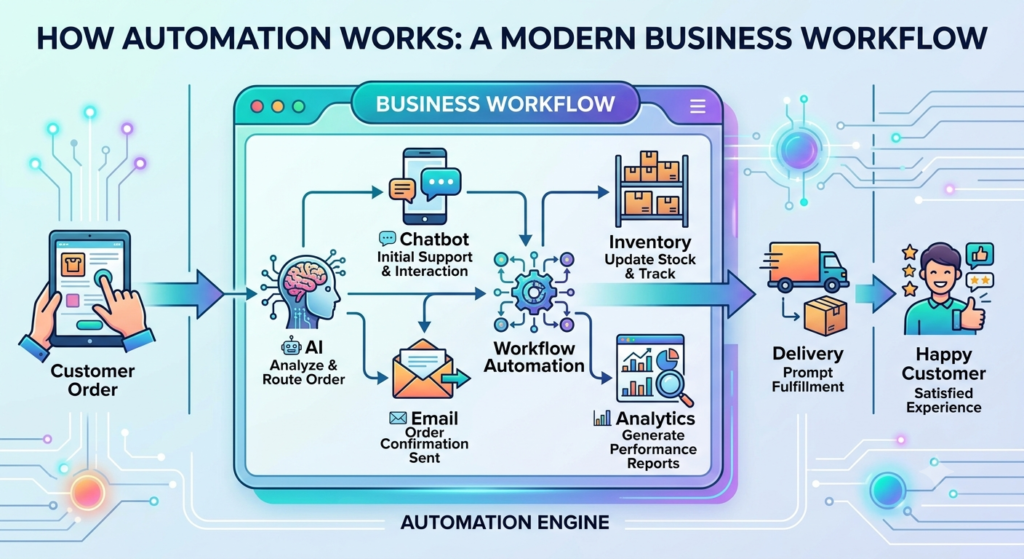
Customer support automation utilizing interactive AI and chatbots handles routine questions and escalates complex ones to the appropriate personnel, thereby decreasing response times and support costs. Marketing and email automation combine AI automation tools (content assistants, segmentation engines) to customize outreach at scale and keep campaigns working efficiently.
Inventory and order management benefit from intelligent automation because AI in business predicts demand, automates restocking, and prevents stockouts in e-commerce and logistics. AI-powered analytics and workflow automation tools can now generate reports, analyze data, and provide business insights with minimal human effort. Overall, automated workflows enhance workflow efficiency, allowing teams to focus on higher-value activities.
How Automation Technology Improves Daily
Automation reduces repetitive tasks, freeing employees from manual data entry and routine validation. This trend shifts employee roles toward leadership, strategy, and creativity. Many organizations upgrade their staff to manage and work collaboratively with intelligent automation systems. Demand for digital skills has increased significantly.
Companies need to know which employees understand AI automation and can design or manage automated processes. The balance between human creativity and machine efficiency is constantly shifting. Automation handles scale and consistency, while humans provide judgment, compassion, and innovation.
Benefits of Automation Technology for Businesses in 2026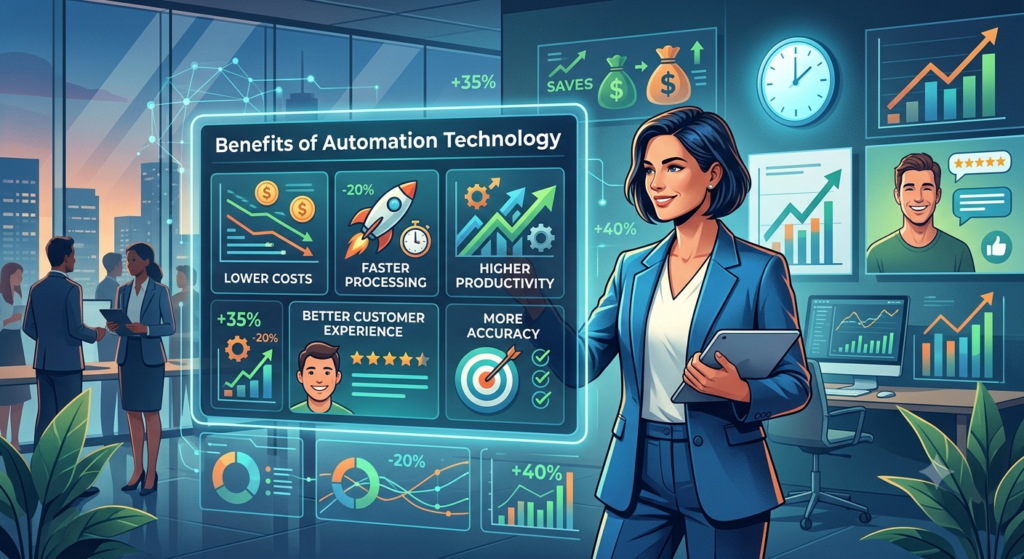
Businesses across industries are experiencing significant benefits from automation technology, including:
- Faster processing: Automation reduces request processing time from hours to minutes, enabling businesses to respond to customers much more quickly. It completes daily tasks in minutes, not hours. This boosts decision cycles and shortens time-to-market.
- Lower costs: Operational costs drop because automated business technologies reduce manual labor, avoid errors, and optimize processes.
- Improved customer experience: AI-powered automation and intelligent systems provide a more seamless experience for customers. They appreciate faster responses and personalized service.
- Enhanced accuracy: Accuracy improves when automated workflows and smart automation reduce human errors in data entry, billing, and rule compliance.
Finally, automation allows companies to scale up. They can handle more transactions without needing more employees. This opens up new ways to make a profit. While automation offers impressive benefits, it also introduces new challenges that businesses cannot ignore.
Industries Using Automation Technology the Most
E-commerce is one of the fastest-growing industries adopting this technology. Online retailers use AI tools to give personalized product recommendations. They base these suggestions on customer behavior and purchase history. Automation handles inventory, processes orders, updates stock levels, and sends shipping notifications automatically. AI chatbots offer quick customer support. They answer common questions and assist shoppers during their buying journey. Automated processes reduce manual work. They boost customer satisfaction and help businesses grow sales and profits.
Healthcare
The healthcare industry is using it to improve patient care and administrative efficiency. It is also well-suited to intelligent automation in various ways. Hospitals and clinics use automation to schedule appointments, manage patient records, and streamline administrative tasks with high efficiency. AI systems aid doctors in patient triage. They help healthcare providers prioritize urgent cases. AI-assisted diagnostic tools help doctors by quickly analyzing medical data. Healthcare organizations can reduce paperwork, prevent errors, and enhance patient care.
Banking and Finance
In the banking and finance sector, automated technology improves both efficiency and security. Financial institutions use AI to automate transaction verification. It helps detect suspicious activities and monitor fraud in real time. Automated reporting systems enable banks to comply with regulations and minimize manual work. These technologies enhance accuracy, reduce costs, and enable employees to focus on delivering advanced financial services.
Logistics companies
Logistics companies rely on automation to enhance warehouse operations, improve inventory management, and increase supply chain efficiency. Industrial robots perform repetitive manufacturing tasks quickly and precisely. Predictive maintenance systems monitor equipment data. They look for signs of potential failures to prevent downtime. Automated warehouse management, inventory tracking, and order processing help businesses deliver products quickly and efficiently. They also lower costs and boost productivity.
Small Businesses
Even small businesses and startups are adopting automation without making large technology investments. Affordable tools like Zapier and Make help businesses automate tasks. These low-code and no-code platforms make it easy to streamline work. Businesses can use them for email marketing, customer follow-ups, invoice generation, and syncing data between apps. These automation tools eliminate manual work and save time. This helps smaller companies compete better with larger ones. They can then focus more on growth and customer service.
Challenges and Risks of Business Automation
Automation provides various benefits, but it also presents challenges. If a business uses an outdated system, the initial startup cost can be high. High setup costs and integration complexity remain challenges for some companies, especially those with legacy systems that require custom automation work. Employee concerns about job displacement often lead to resistance to automation initiatives and upskilling.
Progress in business automation, cybersecurity, and data privacy is becoming increasingly important. These risks increase as automated systems exchange more data across services; firms must secure them with automated workflows and comply with data privacy rules. Overdependence on technology risks failures or vendor lock-in, so companies often design backup processes and choose multiple suppliers.
Future of Automation Technology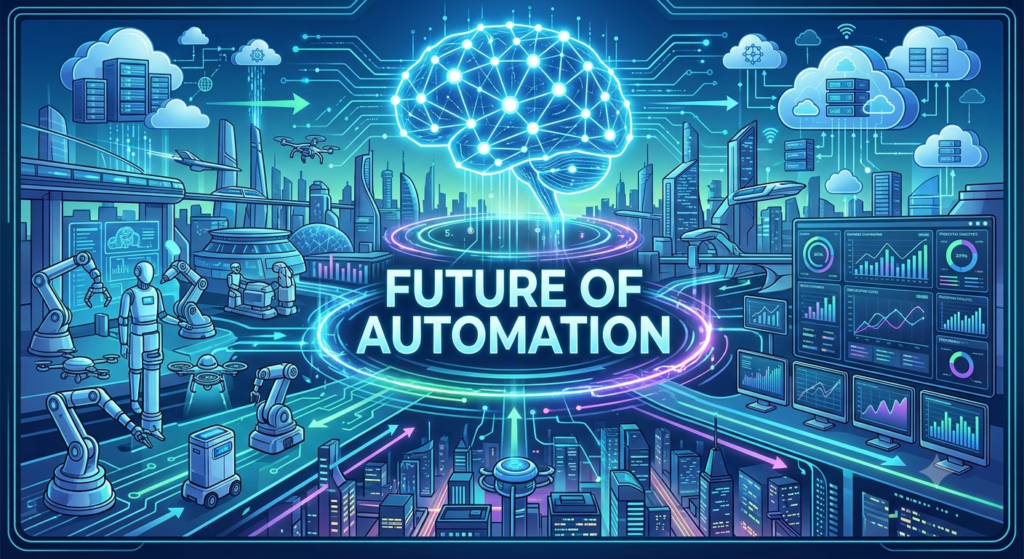
Business automation will continue to evolve as artificial intelligence advances. Some technologies, such as agentic AI, hyperautomation, and predictive analytics, will help users in completing more complex tasks. Hyperautomation, the collaborative use of RPA, AI, and integration platforms to automate complex end-to-end processes, will become mainstream in 2026 and beyond. These trends create new opportunities for startups offering niche AI automation tools and for companies that can transform automated business technologies to gain strategic advantages.
Real-World Examples of Automation Technology
Organizations use automation to improve efficiency.
- KPMG has integrated AI into auditing workflows to analyze financial records more quickly and identify anomalies that would otherwise require hours of manual review.
- Platforms like Microsoft Power Automate, Zapier, and Make help simplify workflows such as data syncing, approval, and notification in business applications. They make it easier for non-engineers to get started.
- An e-commerce clothing store can use Zapier to automate tasks. It can send customer orders from Shopify to Google Sheets. You can also notify the warehouse team via Slack.
- HubSpot and Delve AI demonstrate how marketing and analytics automation enable the creation of personalized campaigns. They also provide large-scale audience insights.
- Industry reports and vendors such as Blue Prism, SCIO Automation, and Turbotic point out major trends for 2026. These include hyperautomation, agentic AI, and cloud-first automation strategies.
A mid-size e-commerce retailer uses AI tools for workflow automation. They use tools like Zapier and a content tool. This setup automatically adds new orders to the inventory system. It also triggers fulfillment with a third-party logistics (3PL) provider. Plus, it sends AI-generated shipment updates to customers. Sales reports are updated, too. As a result, the retailer has cut manual steps from five to one per order. This boosts shipping speed and customer satisfaction.
Final Thought
Businesses that start adopting automation today will be better prepared for future competition. Whether you run a small business or a large enterprise, identifying repetitive tasks and automating them can improve productivity, lower costs, and deliver a more positive customer experience. The sooner companies begin their automation journey, the greater their long-term competitive advantage.
Frequently Asked Questions
What Is Automation Technology in Business?
It uses software, AI, and smart systems to help manage repetitive business tasks with less manual effort. This technology helps companies save time, reduce mistakes, and work more smoothly every day.
Why are businesses using automation so quickly in 2026?
Businesses choose automation to achieve faster results, lower costs, and improved customer service. In today’s competitive market, even a minute’s delay counts. Automation helps companies stay efficient and competitive.
How does automation help employees?
Automation handles dull and repetitive tasks. This gives employees more time for creative and important work. It often changes people’s roles instead of replacing them. This helps them focus on more valuable tasks.
Which Industries Benefit the Most from Automation Technology?
Industries such as e-commerce, healthcare, banking, manufacturing, and logistics have benefited greatly from automation. These businesses handle a lot of work daily. Automated systems help them operate faster and more accurately.
Is automation only useful for big companies?
No, automation is also very useful for small businesses and startups. Small teams can now accelerate and grow with the help of numerous reasonably priced AI tools and workflow platforms. They do this without needing a large staff.