





How to Validate a Business Idea in 2026 Before Launching


Every successful business begins with an idea, but only a small percentage of ideas become profitable. Many startups invest money and long-term effort without knowing what customers want. Launching a startup without understanding customers’ needs is like building a house on sand. Many entrepreneurs overlook validation due to excitement or an emotional attachment to the idea. As a result, many startups struggle to grow, and a big reason for their failure is that they solve problems that don’t exist or target the wrong audience.
Business idea validation is the process of verifying whether real customers want your product, whether they will pay for it, and whether your idea has actual market demand before making a major investment. Validation is more important in 2026 because tools like AI and no-code platforms make it easier than ever to build fast, but they don’t guarantee demand. It helps you collect data, understand customer needs, and reduce the risk of failure.
This guide will help you understand the importance of business validation and create an offer that not only satisfies the needs of your market segment but also attracts your first paying customers. In this guide, we will explain what business idea validation is, why it matters, common mistakes to avoid, useful validation tools, and the signs that indicate your business idea is ready to launch.
What Is Business Idea Validation?
Business idea validation is the process of determining whether your product or service addresses a genuine problem that people are willing to pay for. Rather than building a complete business based on guesswork, entrepreneurs test their assumptions by gathering feedback from potential customers and analyzing market demand to inform their decisions. That’s different from making assumptions, where you say, “I think people will buy this” without any evidence.
A quick real-world example is a founder creating a simple landing page for a meal-prep service, running a small ad test, and collecting sign-ups or pre-orders before cooking a single meal.
Think about it. Would you spend months building something nobody wants? Probably not. That’s exactly why validation matters. It is about learning quickly whether your idea solves a real problem for a specific group of people. According to CB Insights, approximately 35% of startups fail due to a lack of market need. If the response is weak, you avoid building the wrong thing. If the response is strong, you move forward with more confidence.
Why Validating a Business Idea Is Important
Reduces Financial Risk
Starting a test of your idea helps avoid wasting money, time, and effort on a product nobody wants. Instead of hiring a team or building a complex app, test the idea with a simple landing page, survey, or pre-sale. This keeps your early-stage costs low and provides you with data before you commit larger resources. Simply a few days of research can prevent expensive mistakes later.
Helps You Understand Customer Needs
When you validate an idea, it provides valuable insights into your target audience, helping you understand what they are willing to pay for and what frustrates them. Tools like customer discussions and surveys can help identify pain points you might overlook on your own. That data helps you develop a better offer, effective communication, and a more valuable product. You’ll discover their expectations and purchase behavior, allowing you to create solutions that truly solve their problems.
Increase Your Chances of Business Success
Businesses succeed most often when they solve a real problem for a defined audience. Validation enables you to make informed decisions rather than relying on guesswork, resulting in stronger products and more effective marketing strategies. It also helps you improve your business planning by making decisions based on market validation rather than hope.
Common Business Idea Validation Mistakes to Avoid
Building a Product Without Research
One of the biggest mistakes is building first and researching what people need later. Many founders spend weeks or months developing a product before verifying market research to see whether a market exists. A better approach is to research the problem, look for signs of demand, and test the concept with a small audience first.
For example, many founders discover during customer interviews that the problem they planned to solve isn’t the one customers care about. Catching this early can save months of development and thousands of dollars.
Ignoring Customer Feedback
Receiving criticism isn’t always easy, but honest feedback is one of the most valuable resources for improving your business idea. If people tell you your idea is confusing, unnecessary, or too expensive, listen carefully. Ignoring feedback can lead you to build something that looks good to you but fails in the market. The strongest validation comes from behavior, not compliments, so pay attention to what people do, not just what they say. Listening carefully to potential customers helps you identify weaknesses before launching the product.
Relying Only on Friends and Family for Opinions
Friends and family usually want to be supportive, which means their opinions are often too friendly to be useful. They may say your idea is great even when they would never buy it. Real validation comes from your target audience, especially strangers who match your ideal customer profile. Rather, seek opinions from people who match your actual target audience.
Assuming There Is Demand Without Data
Another trap is thinking that if something sounds good, it must have demand. However, business validation requires supporting evidence such as search interest, survey results, pre-orders, or repeat customer inquiries. Without data, you are guessing, and guessing is expensive. Many successful founders spend more time talking to customers than writing business plans. Just 10–15 honest conversations can reveal insights that months of planning cannot.
Best Tools to Validate a Business Idea
Google Trends
Google Trends helps you see whether interest in a topic is increasing, stable, or decreasing over time. It’s also useful for spotting market validation signals and comparing search terms before you launch.
Google Keyword Planner
Google Keyword Planner shows keyword search volume and helps you determine whether people are actively looking for your solution. It is useful when you want to validate a startup idea through search demand and content opportunities.
ChatGPT
ChatGPT can help you brainstorm customer pain points, draft survey questions, create interview scripts, and refine your business concept. It is best used as a research assistant, rather than as proof of demand, because only real users can validate the idea.
Google Forms
Google Forms makes it easy to create simple surveys for customer validation. You can ask people about their problems, preferences, buying habits, and willingness to pay, then collect responses quickly and at low cost.
SurveyMonkey
SurveyMonkey is helpful when you want a more structured survey process with analytics and response tracking. It works well for gathering market research from a larger sample of potential customers.
Typeform
Typeform is useful for conversational surveys that feel more engaging than traditional forms. It is a strong choice for validating a startup idea because it helps you ask better questions and gather deeper feedback from your target audience.
Canva
Canva helps you create polished mockups, social posts, landing page visuals, and product concepts. These visuals are useful for testing reactions before you build, because people often respond better when they can see the idea clearly.
Notion
Notion is great for organizing your validation process, storing survey results, tracking interview notes, and building a simple business planning workspace. It helps keep your research structured so you can spot patterns and make better launch decisions.
Signs Your Business Idea Is Ready to Launch
One of the strongest signals is that customers are willing to pay for your product or service, not just praise the idea. Even a small number of paying customers proves that your solution has real value. 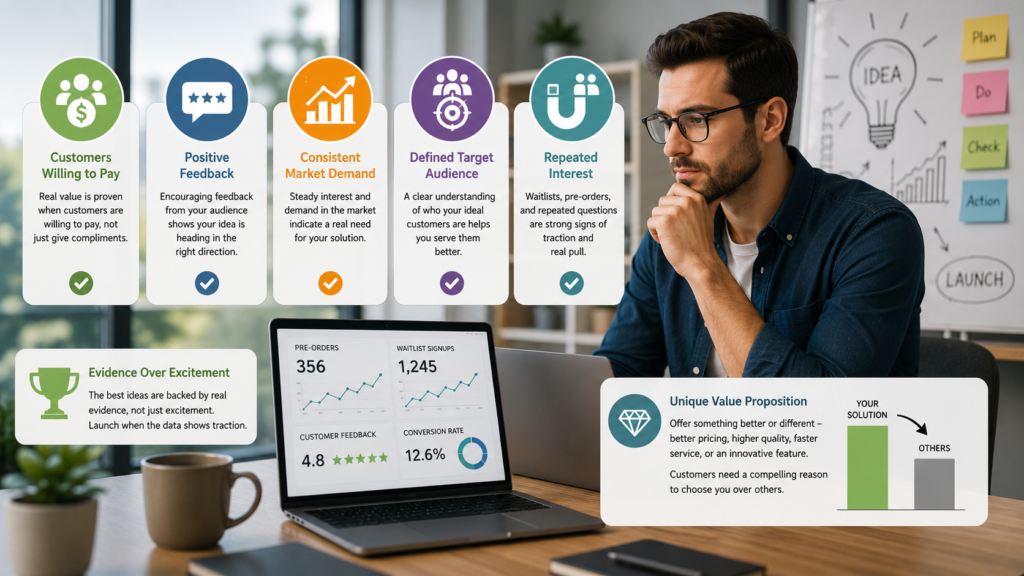
Positive feedback from your target audience is an additional helpful and encouraging sign, but payment intent is stronger. You should also look for consistent market demand, a clearly defined target audience, and a unique value proposition that sets your offer apart.
Another sign is repeated interest over time. If people keep asking for a solution, joining your waitlist, or pre-ordering early access, that’s a practical sign your idea has traction. A good rule is to launch when the evidence shows real pull, not just excitement.
Ultimately, your business should offer a unique value proposition. Whether it’s better pricing, improved quality, faster service, or an innovative feature, customers need a compelling reason to choose your business over competitors.
Final Thoughts
Validating a business idea before launching is one of the smartest ways to protect your time and confidence. It helps you understand whether your concept solves a real problem, whether people want it, and whether they are willing to pay for it. The best founders start small, test quickly, and improve based on feedback instead of waiting for a perfect plan.
The practical takeaway is simple: do not build in silence. Test your idea with a landing page, a survey, a few customer interviews, or a pre-sale, then use the results to decide whether to launch, adjust, or move on.
FAQs
How long does it take to validate a business idea?
It can take anywhere from a few days to a few weeks, depending on the idea and the method you use. Simple tests like surveys and landing pages can move fast, while interviews and pre-sales may take longer.
Can I validate a business idea without spending money?
Yes, you can validate this with free tools like Google Trends, Google Forms, Notion, and social media polls. You may still choose to spend a small amount later on ads or mockups, but it is possible to start with almost no budget.
What is the easiest way to test a business idea?
The easiest method is to create a simple landing page or survey and share it with your target audience. If people sign up, ask questions, or show willingness to pay, you have an early validation signal.
What should I do if my business idea fails validation?
If it fails validation, do not panic. Improve the offer based on feedback. Change the audience if needed. Adjust the pricing, or focus on a better problem to solve.