







Business Automation in 2026: Tools, Trends, Benefits, and Growth Strategies

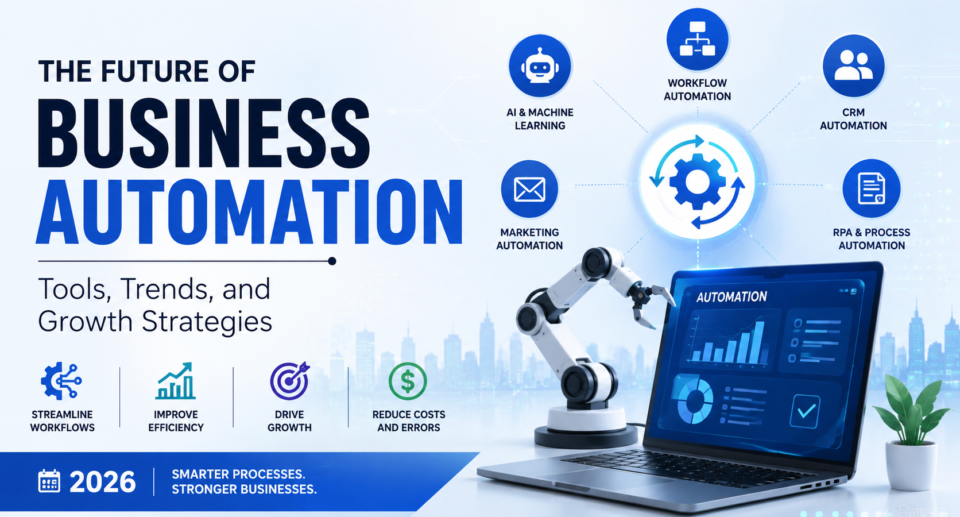
Business automation is transforming how organizations conduct business. It replaces repetitive manual tasks with automated workflows and smart systems. Organizations seeking better efficiency use automation tools. These include workflow builders and AI-driven platforms. They help reduce errors, speed up processes, and let teams focus on more important tasks.
In 2026, automation mixes traditional rule-based systems with advanced AI. This blend enables predictive insights and automated decision-making. In this guide, we’ll explore what business automation means today, look at key tools, highlight major trends, and outline growth strategies. It also weighs the benefits and challenges for teams that want to scale.
What Is Business Automation?
Business automation uses software and technology to handle repetitive tasks. It requires little human input. They vary from basic scripts that follow rules to complex systems. These systems manage multistep operations across different departments.
Why businesses use it: Companies use automation to save money, improve consistency, speed up processes, and reduce human error. Automation enables teams to focus on significant projects, streamline processes, and enhance tracking of results.
Common examples
- Workflow automation for invoice approvals and purchase orders
- CRM automation for lead scoring and follow-ups
- Marketing automation for campaign management
- Chatbots and AI agents for customer support
- Robotic Process Automation (RPA) for data entry
The Evolution of Business Automation
Business automation has undergone large changes over the past few decades. What started as basic rule-based systems has evolved into smart automation. Artificial intelligence and machine learning are driving this change. This evolution shows businesses how modern automation enhances efficiency, scales operations, and improves decision-making.
Traditional Automation
Early automation used scripted macros, scheduled batch jobs, and RPA. These tools mimicked human interactions with older systems. These solutions improved efficiency for specific tasks. However, they required extensive maintenance and weren’t very adaptable.
AI-Powered Automation
Artificial intelligence improvements have converted automation from rule-based execution into adaptive decision-making systems. Over the past decade, machine learning, natural language processing, and decision engines have experienced significant growth. These advancements shift automation from simple scripts to smart, adaptive systems. AI business automation enables processes to learn from data, predict outcomes, and make recommendations. Sometimes, it can even make decisions on its own, but always within set limits.
Current Landscape in 2026
In 2026, automation blends fixed workflows and AI capabilities. No-code and low-code platforms make automated design accessible to everyone. Hyperautomation combines RPA, process mining, orchestration, and AI. It automates complex processes from beginning to end. Integration-first architectures, such as APIs and event-driven platforms, create standardized, connected ecosystems. These ecosystems connect sales, finance, HR, and operations in a unified manner.
Top Business Automation Tools in 2026
Business automation tools are vital for today’s organizations. They streamline workflows, reduce manual tasks, and improve efficiency. In 2026, businesses will have a range of automation solutions to choose from. These include workflow management platforms and AI-powered assistants. Selecting the right tool depends on business goals, process complexity, and integration requirements.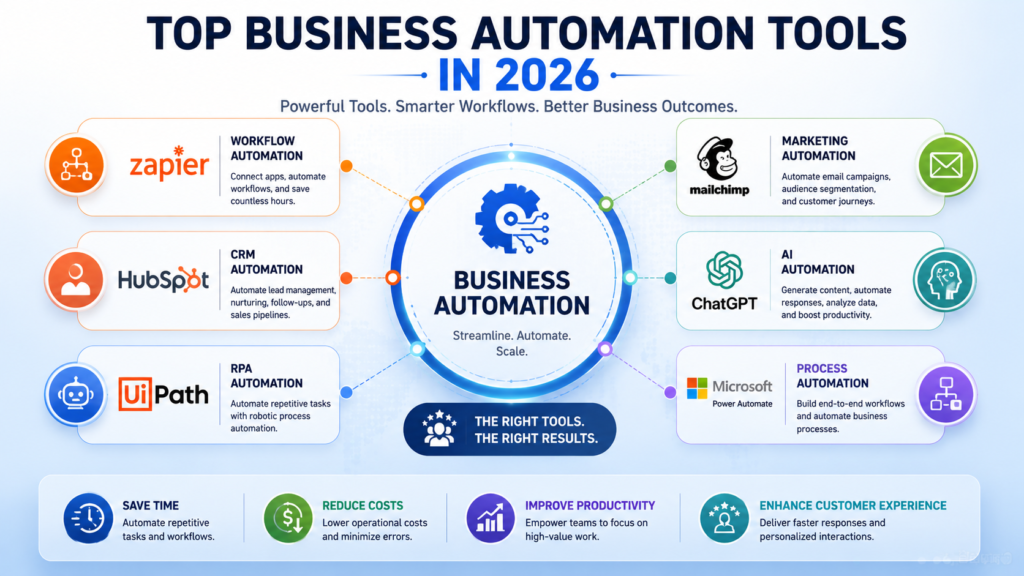
Popular Automation Platforms and Workflow Tools
Advanced workflow platforms, like orchestration engines and no-code builders, help teams. They can create visual designs for multistep processes. Common workflow automation platforms include Zapier, Make, Microsoft Power Automate, and n8n. These tools help businesses connect apps, automate tasks, and reduce manual work. Teams can also trigger actions in response to events and connect to cloud services. They handle approvals, routing, and SLA monitoring with built-in observability.
CRM automation
CRMs increasingly embed automation for lead capture and scoring, account-based workflows, and renewal management. Automation handles tasks such as sending follow-up reminders, creating contracts, and transferring leads from marketing to sales.
Top CRM platforms, including HubSpot, Salesforce, and Zoho CRM, offer automation features. These tools help with:
- Lead nurturing
- Customer segmentation
- Sales pipeline management
- Follow-up scheduling
Marketing automation
Marketing platforms streamline personalization, cross-channel campaign orchestration, and lifecycle messaging. AI augments content recommendations, send-time optimization, and attribution modeling. Popular marketing automation tools include Mailchimp, ActiveCampaign, Klaviyo, and Brevo. These platforms provide information about businesses, automate email campaigns, audience segmentation, and customer engagement workflows.
AI Tools
Generative and decisioning AI can create content, score leads, automate summaries, and power smart virtual assistants. These tools fit into workflows. They give real-time recommendations, draft responses, and escalate exceptions.
AI tools like ChatGPT, Microsoft Copilot, Gemini, and Claude help businesses automate tasks. They make content creation, customer support, data analysis, and workflow recommendations easier. These tools can be integrated with existing business systems to improve productivity and informed decision-making.
| Automation Type | Purpose | Popular Tool | Best For |
| Workflow Automation | Process Management | Zapier | SMEs |
| CRM Automation | Lead Tracking | HubSpot | Sales Teams |
| Marketing Automation | Campaign Management | Mailchimp | Marketers |
| RPA | Repetitive Tasks | UiPath | Enterprises |
| AI Automation | Content creation, decision support, productivity | ChatGPT, Claude, Gemini | Productivity |
| Process Automation | End-to-end business workflow automation | Microsoft Power Automate | Medium & Large Businesses |
These tools support different automation needs. For example, Zapier automates workflows between apps. HubSpot streamlines lead management. Mailchimp handles marketing campaigns. ChatGPT helps with content creation and customer interactions. Selecting the right solution depends on business goals, budget, and operational requirements.
Also read this article: AI in Business Leadership: The Hidden Shift in How Executives Make Decisions in 2026
Key Business Automation Trends for 2026
Business automation continues to evolve as new technologies transform the way organizations operate. By 2026, trends like AI-driven decision-making, hyperautomation, and predictive analytics will boost business efficiency, agility, and scalability.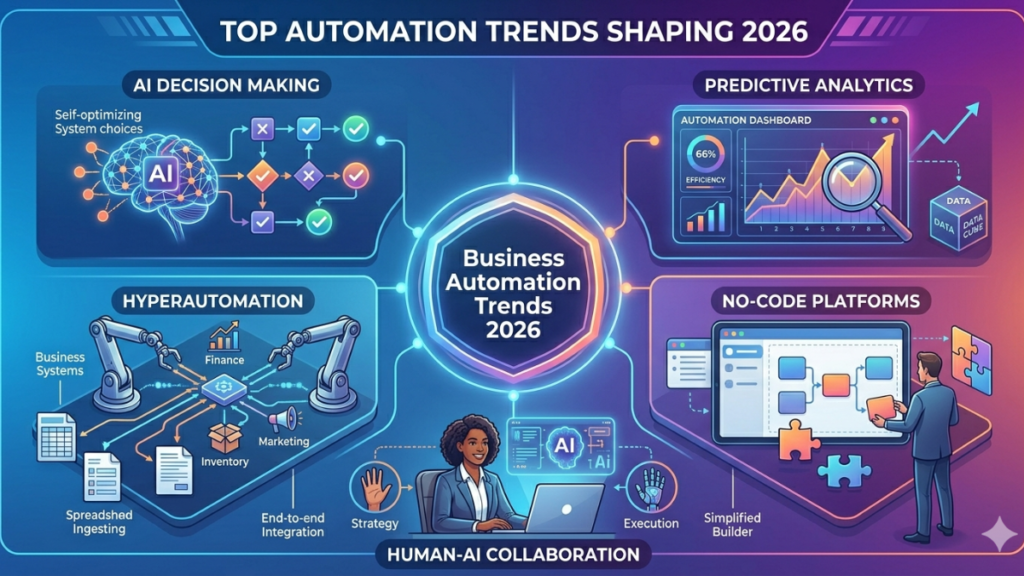
AI decision-making
Organizations are increasingly trusting AI with prescriptive decisions and sometimes making autonomous choices under human oversight. AI decisioning engines blend data, business rules, and risk controls. They facilitate outcomes like approvals, pricing changes, and escalation paths.
Hyperautomation
Hyperautomation is a strategy, not just one product. It combines RPA, process mining, workflow orchestration, and AI. This setup automates entire processes from start to finish. Companies using hyperautomation accelerate cycle times and gain visibility into process bottlenecks.
No-code/low-code tools
No-code and low-code platforms let business users design automation. This speeds up time-to-value and cuts down the IT backlog. Citizen developers can build and iterate automations with governance frameworks to manage risk.
Predictive analytics
Predictive models in automation help spot customer churn, demand spikes, and supply-chain issues. They prompt quick actions, such as automatically restocking inventory or contacting customers at risk.
Growth Strategies Using Business Automation
Businesses utilize automation to reduce manual tasks and boost long-term growth. A solid automation strategy boosts efficiency. It enhances customer experiences and helps organizations grow.
Automate repetitive tasks
Start with common tasks that consume the most employee time. This includes data entry, approvals, and standard reporting. Automating these yields immediate efficiency gains and quick ROI.
Improve the customer experience
Implement automation to minimize response times, route cases effectively, and personalize interactions. Chatbots and automated follow-ups reduce friction while escalating complex issues to skilled agents for future assistance.
Scale operations efficiently
Standardize and codify processes with workflow orchestration. This way, scaling teams or markets won’t raise overhead as much. Automation supports consistent onboarding, compliance checks, and multi-site coordination. B2B e-commerce businesses often use automation. It helps them manage inventory, customer orders, supplier talks, and multi-channel operations effectively.
Use data-driven insights
Instrument automated processes to collect telemetry and outcome data. Apply analytics to identify bottlenecks, measure business impact, and continuously optimize workflows. This approach enables A/B testing of different automation variants.
Benefits and Challenges of Business Automation
Automation boosts efficiency and scalability. However, it brings challenges too. These include integration, governance, and adapting the workforce. Understanding the benefits and limitations helps businesses apply automation more effectively. This leads to long-term success.
Key Benefits
- Increased efficiency: Faster processing and reduced manual labor for repetitive tasks
- Consistency and compliance: Standardized workflows reduce variance and improve regulatory adherence
- Cost reduction: Lower operational costs through fewer errors and less manual effort
- Better decision support: AI-driven insights improve forecasting, personalization, and prioritization
- Scalability: Processes scale without linear growth in headcount
Common Challenges
- Integration complexity: Legacy systems and data silos make end-to-end automation difficult
- Governance and risk: Automated decision-making requires auditability, bias mitigation, and compliance controls
- Employees may resist automation; they need reskilling and clear communication
- Maintenance overhead: Automation requires monitoring and updates as systems and business rules change
- Data quality: Poor data reduces AI effectiveness and can cause erroneous automated actions
Future Opportunities in Business Automation
AI, process mining, and orchestration will continue to converge. This will enable fully autonomous workflows for many back-office and customer-facing processes. Vertical automation suites in sectors like healthcare, finance, and manufacturing will drive adoption.
Human-AI collaboration
The future focuses on teamwork. Humans will supervise and verify to handle exceptions when needed. Meanwhile, AI will manage scale and recognize patterns. Explainable AI and better interfaces will make that collaboration safer and more productive.
Industry impact
Automation will transform jobs and reduce routine tasks, rather than eliminating them. Demand for process architects, AI ethicists, and automation ops engineers is rising. Businesses that combine automation with reskilling will capture the greatest competitive advantage.
Conclusion
Business automation in 2026 is key. It ranges from basic workflow automation to AI-powered, full hyperautomation. When organizations select the right tools and effectively manage automated decisions, they improve the customer experience. This alignment with growth strategies helps them to scale operations and enhance data utilization. This unlocks significant gains in efficiency and innovation.
Successful companies will blend automation with human oversight. They will also invest in integration, data quality, and change management. This approach ensures that they achieve long-term value. Organizations with clear automation goals and quality data will thrive. A blend of AI and human oversight will help ensure sustainable growth in the future.
FAQs
What is business automation, and how does it work?
Business automation uses technology to handle repetitive tasks. This boosts efficiency and cuts costs. It also boosts reliability by swapping manual work for software solutions.
How does business automation improve efficiency?
Automation boosts efficiency. It cuts down on repetitive tasks. This lets employees focus on more valuable work.
What are the best business automation tools in 2026?
Top tools include Zapier (workflow automation), HubSpot and Salesforce (CRM), Mailchimp and ActiveCampaign (marketing), and ChatGPT (AI-powered automation).
Is business automation suitable for small businesses?
Yes, no-code platforms and budget-friendly tools like Zapier and HubSpot simplify automation for small businesses. This helps those with limited technical skills access practical solutions.
What is the future of business automation?
The future includes autonomous AI systems, hyperautomation, and natural language interfaces. It also features human-AI collaboration that improves work instead of replacing it.