





Business-to-Business (B2B) Explained: Types, Benefits, Examples & Trends in 2026

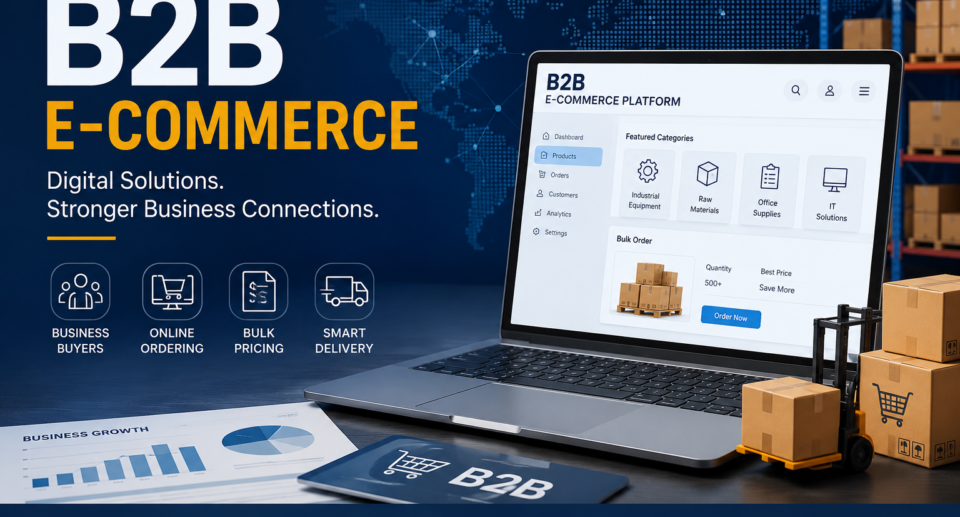
Business-to-business (B2B) represents companies that sell products or services to other businesses. They don’t sell to individual consumers. In today’s digital economy, B2B commerce has undergone a significant evolution. Global B2B e-commerce sales are outpacing B2C sales, according to industry research. This illustrates the significance of digital buying for businesses today. The industry has moved from phone calls and manual buying to online platforms, supply chain systems, and e-commerce sites. Businesses rely on digital platforms to purchase raw materials, software, equipment, and services. These platforms provide catalogs, custom pricing, automated quotes, and easy payment systems. This transformation helps companies reduce costs, improve efficiency, and expand into global markets.
B2B sales differ from B2C sales. They often include bulk orders and negotiated prices. Businesses also focus on long-term partnerships and account management. In 2026, the top B2B online stores blend self-service online experiences with personalized support. This helps businesses handle large and complex orders more smoothly. This article describes B2B e-commerce. It covers its main types, benefits, challenges, and new trends. It also offers practical steps to start and grow a successful B2B online marketplace business.
What is business-to-business (B2B)?
B2B refers to commercial transactions in which both the buyer and the seller are businesses.
Here are some examples:
- A steel mill sells to an auto-parts maker.
- A cloud provider offers compute services to software companies.
- The marketing agency uses another company to provide analytics tools.
B2B (business-to-business) deals differ from B2C (business-to-consumer) in multiple ways. They tend to have bigger order sizes and longer sales cycles. Contracts are usually negotiated. Many people on the buyer’s side get involved. These can include procurement managers, technical evaluators, finance teams, and end users.
B2B relationships emphasize reliability, long-term partnerships, and operational fit.
Buyers look at suppliers based on:
- Product quality
- Delivery lead times
- Regulatory compliance
- Integration capabilities
B2B sales and marketing often rely on account-based strategies. They use content that shows ROI. They also appreciate relationship building over impulse-based ads. Digital transformation has changed how businesses purchase things and source suppliers. But the fundamentals—trust, terms and service—are as important as they ever were.
Types of B2B E-Commerce
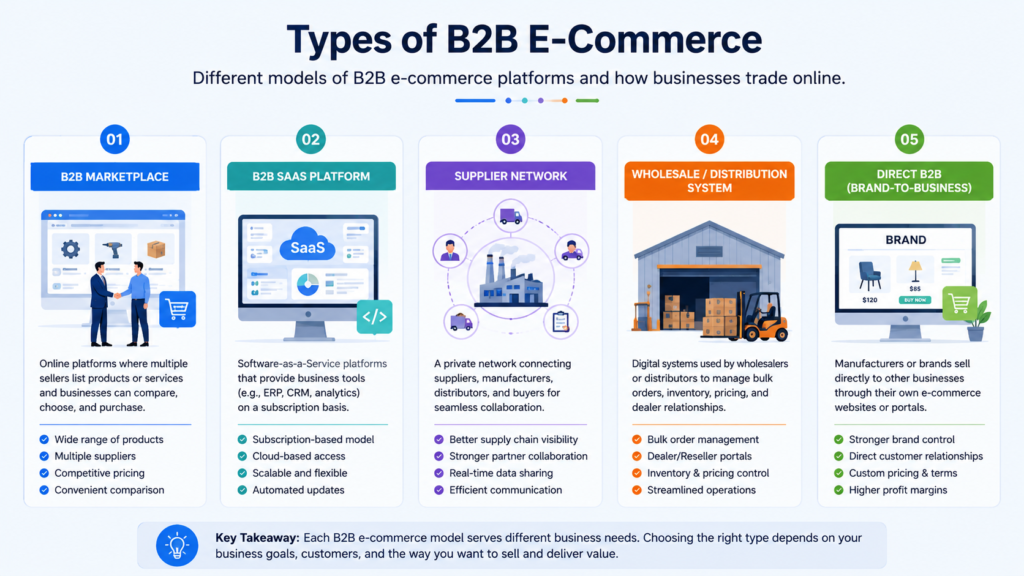
B2B e-commerce comes in severalmodels:
- Supplier-Facing Marketplaces: These are platforms where suppliers showcase products for various business buyers. An example is industry-specific marketplaces.
- Buyer-Led Procurement Platforms: These systems allow large companies to let approved suppliers bid on or list products for their internal buyers.
- Vertical Marketplaces: Niche marketplaces serving a single industry (manufacturing, healthcare, construction)
- Horizontal Marketplaces: Broad platforms offering products across industries (e.g., office supplies, IT hardware)
- Direct Brand Commerce: Companies sell directly to other businesses through their websites.
- Software-as-a-Service (SaaS) Marketplaces: Platforms that sell enterprise software. They offer integrations, subscription billing, and seat-based licensing.
Each model meets different buyer needs. Each model serves different buyer needs. Some highlight price transparency and product variety. Others focus on compliance, trusted vendor networks, and deeper integrations. Others focus on compliance, trusted vendor networks, and deeper integrations.
Benefits of B2B E-Commerce
B2B e-commerce delivers several measurable advantages:
- Lower transaction costs: Automated ordering and invoicing cut manual work and reduces errors.
- Faster order cycles: Self-service portals and real-time inventory information speed procurement. Digital procurement systems make purchasing easier. They help businesses save time and boost efficiency.
- Scalability: Suppliers can manage multiple accounts via digital platforms without hiring more salespeople.
- Better data and forecasting: Digital transactions create data. This data helps with demand forecasting, inventory planning, and customer insights.
- Improved customer experience: Personalized catalogs and saved order templates help repeat customers shop easily. Easy subscription options also enhance convenience.
- Expanded reach: Suppliers can reach new markets and niche buyers online.
- Transparent pricing and contract management help clarify commercial terms. Tiered pricing, contract-based catalogs, and integrated discounts make things easier.
For example, a small industrial equipment supplier can use a B2B e-commerce site. This lets them reach customers in various countries without needing physical offices. So, they can expand their market and boost revenue.
Challenges in B2B E-Commerce
B2B e-commerce faces several challenges that complicate online selling and buying in Startup. Complex pricing requires a special catalog and pricing system. This includes customer-specific rates, volume discounts, and contract terms. Long sales cycles with many decision-makers slow conversions and demand tailored account management. High competition in market places pressures margins and forces differentiation. Payment and security issues increase with large transactions. This makes strong fraud prevention and secure payment solutions essential.
Logistics for bulk shipments are complex, involving warehousing, customs, and variable lead times. Customer retention can be tough. Buyers often switch suppliers for better prices or availability. Consistent service, reliable fulfillment, and strong relationship management are key to long-term success.
B2B vs B2C E-Commerce
Key differences between B2B and B2C include the following:
| Features | B2B | B2C |
| Buyers | B2B buyers are organizations with multiple stakeholders | B2C buyers are individuals |
| Pricing | B2B uses negotiated or tiered pricing | B2C uses fixed retail prices |
| Order Size and Frequency | B2B orders are larger and often recurring | B2C orders are smaller and more transactional |
| Sales process | B2B focuses on building relationships, managing contracts, and handling accounts. | B2C emphasizes creating conversion funnels and running marketing campaigns. |
| Payment methods | Supports net terms, purchase orders, and invoicing | Focuses on cards and instant payments |
| Integrations | B2B requires ERP/CRM integrations and compliance checks. | B2C requires CRM and marketing automation, with fewer enterprise integrations. |
| Customer experience | B2B emphasizes efficiency and accuracy | B2C emphasizes speed and emotional engagement |
Best B2B E-Commerce Platforms in 2026
Several platforms are helping businesses build powerful B2B online stores in 2026.
Shopify Plus
Shopify Plus is a popular solution for businesses that need scalable e-commerce features. It offers automation tools, secure payment systems, and easy customization.
WooCommerce B2B
WooCommerce is a flexible WordPress-based platform suitable for small and medium-sized businesses. It allows businesses to create customized B2B stores at affordable costs.
Magento Commerce
Magento Commerce provides advanced features for large enterprises. It supports complex product catalogs, customer segmentation, and enterprise-level integrations.
BigCommerce
BigCommerce is known for its scalability and SEO-friendly features. Many growing businesses use it to manage large online stores efficiently.
Alibaba
Alibaba is one of the largest B2B marketplaces in the world. It connects manufacturers, suppliers, and buyers globally.
How B2B E-Commerce Works
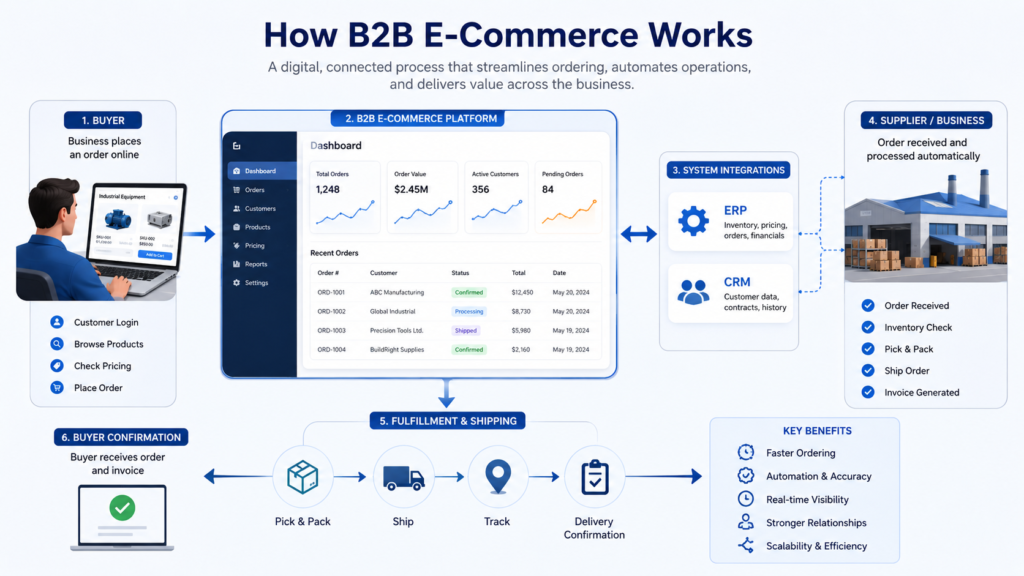
B2B e-commerce platforms make purchasing a breeze for businesses. They digitally transform item control, ordering, payments, and customer communication. These platforms usually have product catalogs with custom pricing. They handle bulk orders. They manage user accounts. This woralso integrates with ERP, CRM, and payment systems. Buyers often start by finding suppliers through search engines, marketplaces, or referrals.
Businesses can review product specs, compare prices, and request custom quotes. They then place orders through online portals using sales orders and digital payments. Suppliers manage fulfillment, shipping, invoicing, and post-sale support through automated systems. In 2026, automation tools like smart inventory management and data-driven forecasting will help businesses. They will reduce costs, improve efficiency, and make purchasing easier for long-term growth.
Example: A manufacturing company can use a B2B e-commerce platform. This helps automate the bulk purchasing of raw materials. Companies can now reorder inventory online. This way, it avoids contacting suppliers for each order. It can also track shipments in real time and reduce delays.
Top B2B E-Commerce Trends for 2026
In 2026, B2B e-commerce will use headless and composable architecture. This helps companies create faster, tailored buying experiences. AI tools automate quoting, personalization, and demand forecasting. Marketplaces are growing, especially industry-specific platforms. They connect trusted suppliers with buyers who need compliance and traceability. Subscription and consumption-based pricing continues to rise as businesses prefer predictable billing, replenishment, and usage.
Mobile-first procurement portals with embedded workflows linked to ERPs allow for straight-through processing. This cuts down on manual approvals. Sustainability and supply chain transparency are becoming more important. Flexible financing options like BNPL help businesses manage cash flow more effectively. Together, these trends push B2B sellers toward agile, data-driven commerce models.
Important trends shaping B2B commerce this year include:
- Headless and composable commerce
- AI-driven quoting and personalization
- Embedded procurement workflows
- B2B marketplaces
- Subscription and consumption models
- Sustainability and traceability
- Mobile-first B2B experiences
- Payments and financing
How to Start a B2B E-Commerce Business
Follow these steps to launch:
-
- Define your niche and value proposition. Identify the industry, product category, and pain points you solve.
- Validate demand. Talk to potential buyers, run pilot orders, or test with a minimum viable catalog. For example, if you want to sell office supplies to businesses, start small. Have a limited product catalog and test demand. Work with a few local companies first. Then consider expanding nationwide.
- Choose the right platform. Match your scale and integration needs. Consider headless options if you want a custom frontend.
- Build integrations. Connect to ERP, accounting, shipping, and CRM systems. This automates processes and reduces manual work.
- Configure pricing and contracts. Implement customer-specific catalogs, tiered pricing, and approval workflows.
- Set up fulfillment and logistics. Establish warehousing, lead times, and returns processes; consider 3PL partners if needed.
- Launch marketing and sales. Use account-based marketing, content that proves ROI, SEO, and targeted outreach to decision-makers.
- Train customers and staff. Provide onboarding, documentation, and support to encourage platform adoption.
- Measure and iterate. Track metrics like:
-
- Order cycle time
- Average order value
- Conversion rates
- Customer retention
Then, refine your offerings using this data.
Final Thoughts
B2B e-commerce since 2026 combines quick online processes with solid relationships in wholesale and enterprise sales. Successful sellers use flexible platforms with deep integrations. They rely on data-driven automation. At the same time, they maintain account management for complex deals. Businesses should prioritize the buyer experience and reliable fulfillment to build long-term customer relationships.
This is important for everyone:
- Manufacturers selling directly to businesses
- Online Distributors
- SaaS providers looking to scale their sales operations
Also, choose platforms that allow for customized pricing and purchase workflows. Focus your efforts on targeted content and SEO to reach decision-makers. Stand out by utilizing trends such as headless commerce, AI-powered quotes, and subscription models. A solid strategy can help B2B digital channels. It can cut costs, expand reach, and strengthen business ties.
FAQS
How should a small supplier price when competing with large distributors?
Rather than matching the lowest cost, use value-based tiers. Offer bundled products, faster lead times, easy return policies, and flexible minimum order quantities. Pay attention to the entire cost of ownership. Think about training, warranties, and dependability. This enables consumers to consider factors other than the unit cost.
What legal and tax issues should B2B e-commerce sellers expect when selling internationally?
Make plans for import/export licenses, customs charges, and VAT/GST. Additionally, make sure the product complies with national regulations. Use commercial invoices, HS codes, and clear Incoterms; collaborate with a 3PL or customs brokers. Make sure your platform applies tax per jurisdiction and get cross-border tax counsel.
How can B2B companies adhere to privacy regulations while ethically using consumer data?
Gather only the information required for a specific goal. Keep it secure. When possible, use anonymized data for analytics.nSend out privacy alerts. Respect the rights to access, correction, and deletion